
Trading journal vs spreadsheet: what actually changes
Product research based on TDLab workflows, hands-on testing and cited source material.
Almost every trader who decides to get serious starts the same way: a spreadsheet. A row per trade, a few columns for entry, exit, size and P&L, maybe a notes field. It is free, it is flexible, and for the first few weeks it feels like enough.
Then the spreadsheet quietly stops working — not because the data is wrong, but because it can only answer the questions you already thought to ask. The questions that actually move your equity curve are the ones a spreadsheet makes painfully hard to answer.
Short answer
Use a spreadsheet if you only need a flexible trade ledger. Use a behavioral trading journal when you need to find which mistakes, setups, sessions or rule breaks are hurting performance — and when you want a repeatable review process instead of another sheet to maintain.What a spreadsheet is good at
Let's be fair: a spreadsheet is an excellent ledger. If your goal is to record outcomes and compute a few aggregate stats — win rate, average win/loss, expectancy — it does the job and you stay in full control of your data.
The friction starts when you want to move from recording to review:
- Manual entry is fragile. Copy-pasting fills from your broker is slow and error-prone, so most traders stop logging consistently after a bad week — exactly when the data matters most.
- Behavior is invisible. A spreadsheet stores the outcome of a trade, not the decision behind it. Was that a planned entry or a revenge trade? Did you size up because of conviction or because you were down on the day?
- No feedback loop.A ledger tells you what happened. It does not tell you whether you followed your own rules, or what it cost you when you didn't.
The question a spreadsheet can't answer
Here is the question that separates a journal from a ledger: which behaviors are driving my P&L?
Answering it requires three things a spreadsheet doesn't give you for free: structured tagging of mistakes and setups, a way to measure the dollar impact of each behavior, and a record of whether you actually followed your plan. You can bolt some of this onto a spreadsheet with enough formulas and discipline — but the maintenance cost grows until journaling becomes a second job.
The core difference in one line
A spreadsheet answers "what was my P&L?". A behavioral journal answers "which of my behaviors produced that P&L, and am I repeating the expensive ones?"What a behavioral journal adds
A purpose-built journal isn't just a nicer spreadsheet. It changes the workflow from logging to learning:
- Import and sync. Trades can enter through MT4/MT5 auto-sync, cTrader auto-sync or custom CSV/report imports, so you spend your energy on review instead of maintaining rows by hand.
- Mistake-impact analytics.Tag setups and errors once, then see the cumulative P&L attached to each behavior — "moving my stop" or "trading outside session" gets a real number next to it.
- Rule adherence tracking. Define your rules in a playbook, then measure how often you actually follow them. Discipline stops being a feeling and becomes a metric.
- What-if simulation.Test a rule against your real history — "what if I never traded the first 15 minutes?" — before you commit to it.
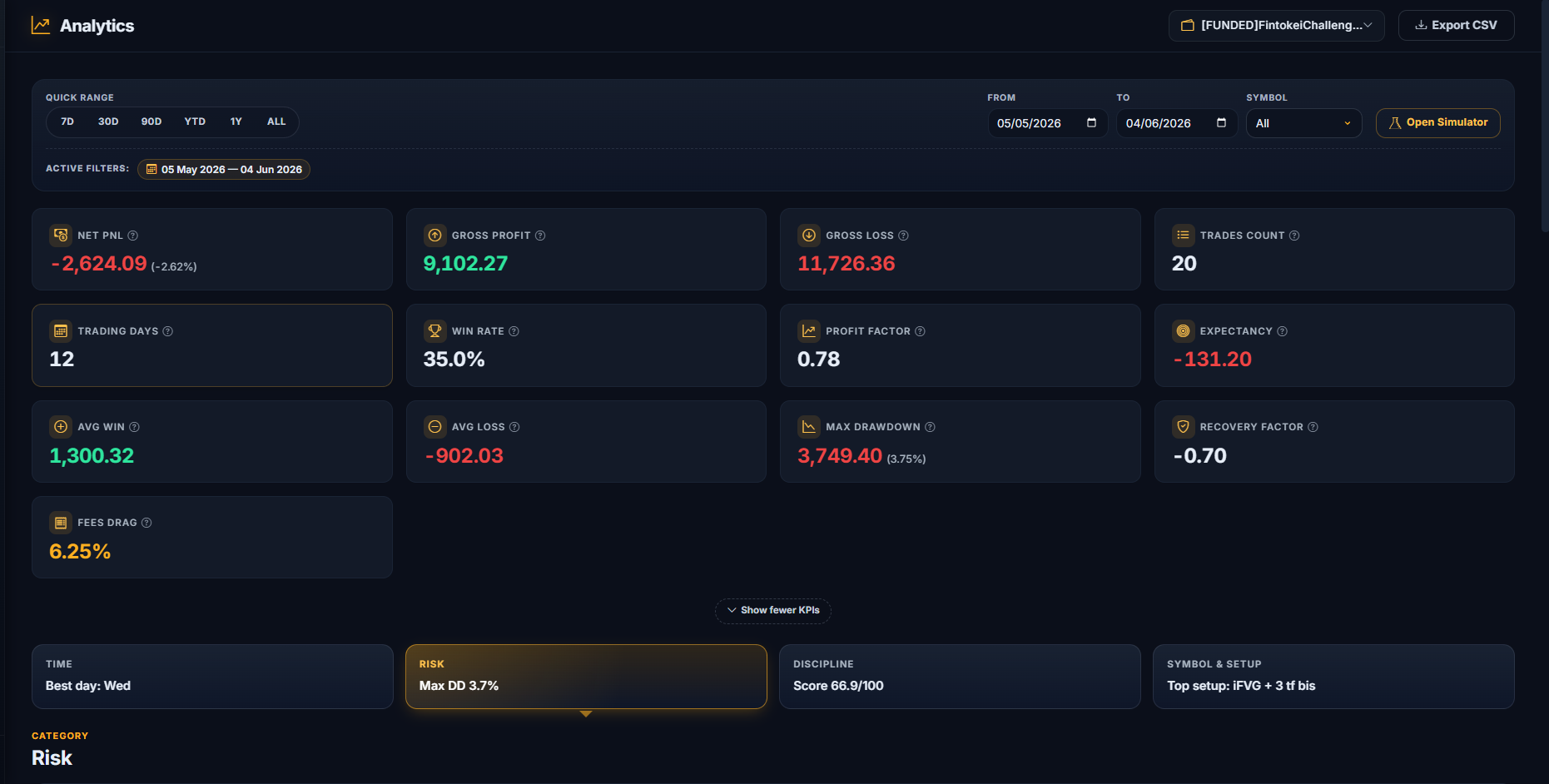
Spreadsheet vs trading journal: the practical difference
The real difference is not the interface. It is the feedback loop. A spreadsheet can show your average win, average loss and total P&L. A behavioral journal should help you decide what to change next.
- For record-keeping: a spreadsheet is often enough.
- For finding behavior leaks: you need structured review fields such as setup, discipline mistake, followed plan, execution quality and emotion.
- For changing behavior: you need rule adherence, what-if simulation and weekly review, not just more columns.
When should you switch?
If you trade occasionally and only want a record, a spreadsheet is fine. Switch to a dedicated journal when you notice the pattern that traps most people: you know you keep making the same mistake, but you can't put a number on what it's costing you, so you never prioritize fixing it.
That gap — between knowing a behavior is bad and seeing exactly how expensive it is — is the entire reason behavioral journals exist. That is the gap TDLab is built to close.
If you are comparing dedicated journal platforms, read our sourced comparisons. Each one shows where the competitor is the better fit instead of pretending one tool is right for every trader.
- TDLab vs TradeZella for a broad journal with replay, backtesting and automation.
- TDLab vs Edgewonk for behavior-first journaling and psychology analytics.
- TDLab vs TraderSync for AI coaching, strategy planning and market replay.
- TDLab vs TradesViz for multi-asset analytics, simulators and a free stock tier.
Common questions
Is a spreadsheet enough for a trading journal?
Yes, if you only need a record of trades and basic stats. It becomes limiting when you need consistent review, mistake impact, rule adherence or simulations on your real trade history.
What should a trading journal track beyond P&L?
At minimum: setup, tags, discipline mistakes, whether you followed the plan, execution quality, notes, emotions and the context around the trading day. Without those fields, it is hard to connect results to decisions.
When is it worth moving from a spreadsheet to software?
Move when the maintenance cost of the spreadsheet starts hiding the actual work: reviewing decisions, identifying repeated mistakes, testing rules and checking whether your discipline is improving.
Try it on your own data
TDLab imports your real trades, attaches a cost to each behavior, and tracks whether you follow your own rules. Start with a free 7-day trial — no spreadsheet migration headache.Keep the flexibility. Remove the maintenance.
Import your trades into TDLab when maintaining formulas and review tabs starts taking more time than investigating the decisions themselves.