
What Is a Trading Journal? A Practical Guide for Serious Traders
Product research based on TDLab workflows, hands-on testing and cited source material.
A trading journal is a structured record of your trades, decisions and review notes. At the simplest level, it stores entries, exits, position size, instrument, result and screenshots. At a serious level, it helps you understand why a trade happened, whether it followed your plan and which patterns are helping or hurting performance.
That distinction matters. Many traders think a journal is just a trade log. A trade log tells you what happened. A useful trading journal helps you decide what to change next.
Short answer
A trading journal is a repeatable review system for your trading history. It records the trade, the context, the decision quality and the behavior behind the result, so you can find patterns that are hard to see from P&L alone.What does a trading journal track?
Most journals start with the same base data: symbol, direction, entry, exit, size, date, time, fees and net P&L. That data is important, but it is only the accounting layer. It tells you the outcome, not the quality of the decision.
A serious trading journal should also track:
- Setup: the strategy, pattern or playbook idea that justified the trade.
- Plan adherence: whether the trade followed the plan you had before entering.
- Execution quality: how well you executed the idea, separate from whether the trade won or lost.
- Discipline mistakes: behaviors such as chasing, revenge trading, moving stops, overtrading or entering outside your rules.
- Market and personal context: notes about the day, volatility, emotion, focus, fatigue or news context.
- Review status: whether the trade has actually been reviewed, not just imported.
Why traders use a journal
The obvious reason is record keeping. You need to know what you traded and how much you made or lost. But the deeper reason is feedback. A trader improves by making the review loop shorter and more honest.
Without a journal, every week tends to become a vague story: "I had bad discipline", "I forced trades", "I missed the good setups", "I was unlucky". Those statements might be true, but they are too blurry to act on. A journal turns them into evidence.
- Which setup produces the cleanest trades?
- Which mistake costs the most money?
- Are losses after a losing trade worse than normal losses?
- Do certain hours, weekdays or account conditions create bad decisions?
- Are you losing because the strategy is weak, or because you are not following it?
The real job of a trading journal
The goal is not to collect beautiful notes. The goal is to make your trading behavior visible enough that you can change it.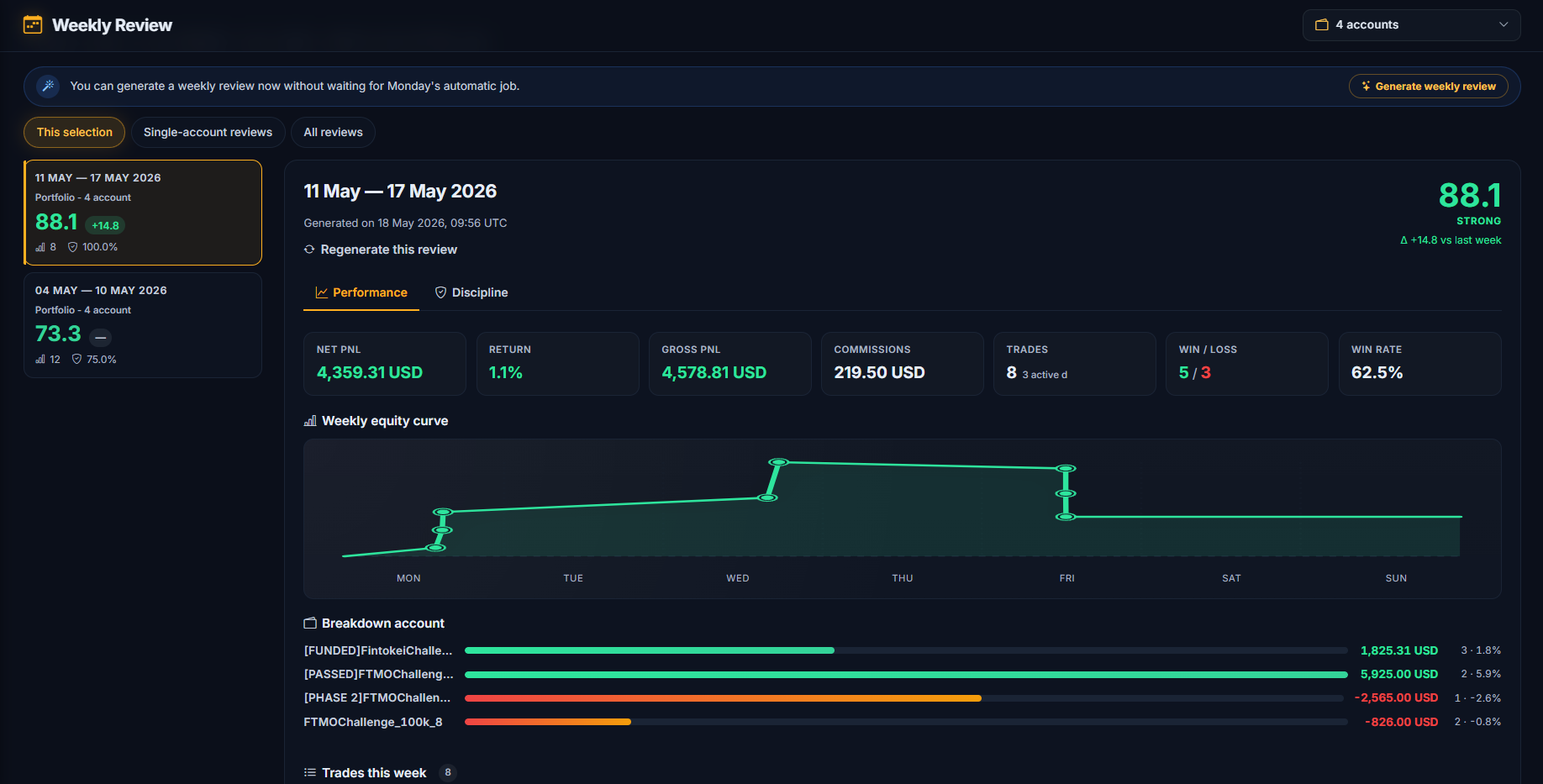
Trading journal vs trade log
A trade log is a ledger. It stores what happened: buy here, sell there, win, loss, fee, net result. That is useful, especially for basic analysis and accountability.
A trading journal goes further. It connects the result to the decision process. It asks whether the trade matched the plan, what mistake was present, what setup was used, what the trader was trying to do and what should happen differently next time.
If you are still using a spreadsheet, that is a reasonable starting point. We wrote a separate guide on trading journals vs spreadsheets for traders deciding when a spreadsheet stops being enough.
How to use a trading journal without turning it into homework
The most common mistake is making the journal too ambitious. Traders create twenty fields, write long emotional notes for three days and then abandon the process. A good journal has to be repeatable after a boring day, a losing day and a day when you do not feel like reviewing anything.
A practical workflow looks like this:
- Import or record the trades. Capture the objective trade data first.
- Review the trade. Mark setup, plan adherence, execution quality, mistakes and context.
- Look for repeated behavior. Do not overreact to one trade. Look for clusters.
- Attach numbers to behavior.A mistake matters more when you can see its total P&L impact.
- Choose one rule to test. Do not try to fix everything at once.
- Review weekly. The weekly review is where scattered trade notes become a decision about what to improve next.
What makes a trading journal useful?
A journal becomes useful when it changes behavior. That usually means it has five qualities.
1. It is consistent
The best journal is the one you actually keep using. Automation helps, but consistency also comes from keeping the review fields simple enough to fill out every day.
2. It separates outcome from process
A profitable trade can still be a bad trade. A losing trade can still be well executed. Your journal should make that distinction visible.
3. It tracks behavior, not only stats
Win rate and average win/loss matter, but they rarely explain the full story. Setup quality, discipline mistakes, plan adherence and execution quality often explain what the headline stats hide.
4. It points to the next action
If a journal produces more charts but no decision, the loop is incomplete. The review should lead to a concrete question: what rule, limit or behavior should I test next?
5. It can be reviewed over time
One review is useful. A month of consistent reviews is much more valuable. The real edge comes from seeing which patterns survive over many trades.
A quick TDLab note: where we differ from a normal trading journal
TDLab is a trading journal, but it is not built around the idea that logging trades is the final goal. It is built around a discipline loop: find what is sabotaging performance, test a corrective rule on your real history and then track whether you follow that rule in the future.
That changes the product in a few important ways:
- Discipline analytics sit next to performance stats. You can review P&L, but also mistake impact, post-loss behavior, followed-plan gaps, execution quality and other behavioral signals.
- The simulator is focused on behavior. It is not a market replay or a strategy tester. It asks questions like: what if I stopped trading after a loss, avoided a costly mistake, excluded a weak time block or only took followed-plan trades?
- Rules can become measurable. A rule should not live only in a notebook. In TDLab, rules can move into a playbook and be checked against future trades.
- The weekly review is part of the loop. The goal is to keep turning trade history into one specific improvement, instead of collecting more disconnected notes.
- The AI layer is account-grounded. The AI Discipline Analyst is designed to explain the evidence in your account and help turn it into action plans, not replace your trading process with generic advice.
TDLab in one sentence
Use TDLab when you do not just want to know what your P&L was. Use it when you want to know which behaviors are sabotaging that P&L and what rule you should test next.Common questions
Do beginner traders need a trading journal?
Yes, but it should be simple. Beginners usually need consistency, screenshots, setup labels and notes on whether they followed the plan. Advanced analytics become more useful once there is enough trade history to compare patterns.
Can a spreadsheet be a trading journal?
Yes. A spreadsheet can be a trading journal if it records trades, context and review notes. The limitation is maintenance: as soon as you want mistake impact, rule adherence, weekly review or simulation, a spreadsheet becomes harder to keep accurate.
What is the most important thing to track?
Beyond basic trade data, the most important field is whether the trade followed your plan. That single question separates strategy problems from discipline problems.
How often should you review your trading journal?
Review trades shortly after they close, then do a weekly review to find repeated patterns. Daily review catches details; weekly review shows what is worth changing.
Try a discipline-first journal
TDLab imports your trades, helps you review the behavior behind them and turns repeated leaks into rules you can test. Start with your real history and see what is actually costing you.Turn the journal into a review loop.
Bring trades, decision context and weekly review into one process, then use the evidence to choose the next rule worth testing.